Intent
The request and its agreed interpretation.
See what an agent’s change means for your project. Connect the intent, code, and evidence. Make an informed decision.
AgenticConsensus is a shared, versioned project state for human–AI coding collaboration.
Illustrative scenario Explore any step ↗
Behind the project
01 / A closer look
A working connector quietly broadens access. Follow the mismatch from the original request to the review decision.
 Consensus Control /
Capability migrationIllustrative walkthrough
“Use task-scoped access.
Keep the existing connectors working.”
Legacy exceptions need a scope and an expiry.
Keep the interpretation and who agreed on record.
− from task_auth import get_token+ from workspace_auth import get_token
The new dependency may violate task scope. Dynamic credential resolution can remain unobservable.
Evidence must support this claim, on this version—not just show a passing result.
Resolve the access-policy mismatch and supply current evidence.
* Only where policy permits. Every decision records its actor, rationale, scope, and exact project version.
Illustrative capability-migration scenario. No live repository actions or measured results.
02 / The consensus layer
Prompts get buried. Code keeps changing. A shared project state preserves the decisions that connect them.
The request and its agreed interpretation.
The interfaces, dependencies, and rules to preserve.
The code and configuration at a specific revision.
What was checked, for which claim and version.
Consensus means an authorized project state. Disagreements, uncertainty, and scoped exceptions remain visible.
Context travels both ways. Agreed changes guide implementation; changed artifacts reveal conflicts and stale evidence.
03 / The working system
The open-source review workspace. Inspect a commitment, follow it into the code, and see what still needs evidence.

An agreed commitment, beside the code. An English-only synthetic demo. Linked files are marked “Not interpreted” until a source reading is recorded.

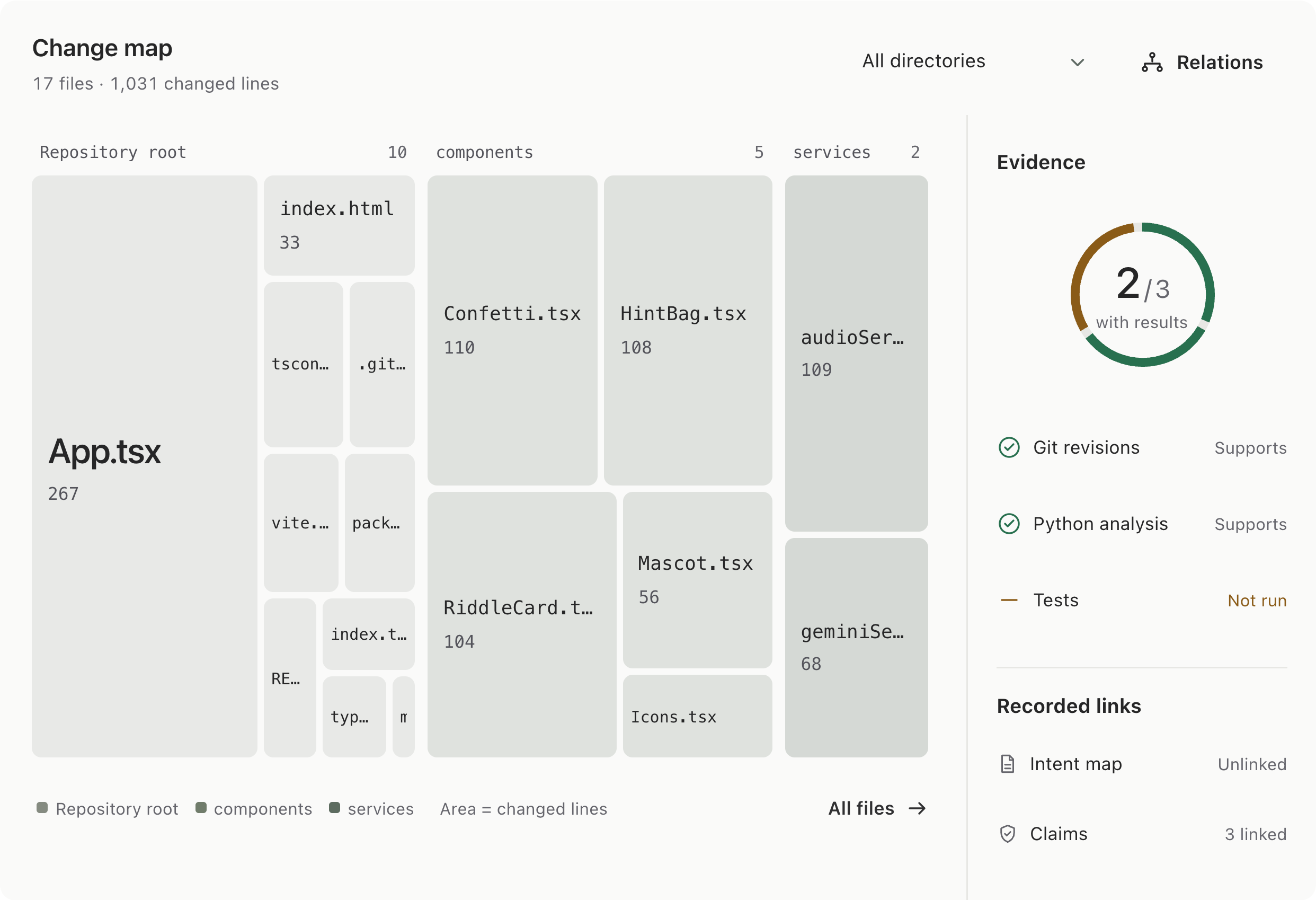
Three claims still need evidence. Approval stays blocked until the requirements are resolved.
Know what blocks approval. An AI answer can inform a decision; it cannot authorize one.
Local-first. Read-only GitHub import. Optional AI. Captures from the development workspace. See the FAQ for implementation scope.
Run the workspace04 / The research
Our position: more agent-written code needs a shared account of what the project means—and who can change it.
1 HKUST (Guangzhou) 2 Zhejiang
University 3 Tencent
* Corresponding authors
arXiv:2604.17883 · First submitted 20 April 2026. Updated version coming soon. This site follows our newer research and implementation.
Code records what was built. It does not, by itself, explain the choices a project has agreed to preserve. AgenticConsensus links intent, commitments, artifacts, and evidence in a versioned project state that people and agents can inspect and revise.
Agreed changes guide implementation. Updated artifacts reveal conflicts, gaps, and stale evidence. Consensus Control puts this approach into a review workspace, with humans retaining decision authority.
05 / Try it on your machine
Try the demo, import a GitHub PR, or compare local Git revisions.
git clone https://github.com/GeminiLight/AgenticConsensus.git
cd AgenticConsensus
uv venv .venv
uv pip install --python .venv/bin/python -e '.[dev]'
.venv/bin/agentic-consensus demo
.venv/bin/agentic-consensus servehttp://127.0.0.1:8765 and create the local
administrator.[email protected].
06 / Go deeper
Read it. Run it. Build on it.
@misc{wang2026scalinghumanaicodingcollaboration,
  title = {Scaling Human-AI Coding Collaboration Requires a Governable Consensus Layer},
  author = {Wang, Tianfu and Hao, Zhezheng and Wu, Yin and Wu, Wei and Lin, Qiang and Dong, Hande and Yuan, Nicholas Jing and Xiong, Hui},
  year = {2026},
  eprint = {2604.17883},
  archivePrefix = {arXiv},
  doi = {10.48550/arXiv.2604.17883},
  url = {https://arxiv.org/abs/2604.17883}
}
A few useful distinctions
No. Consensus is the authorized project state, including unresolved claims and scoped exceptions. Agent agreement alone does not establish truth or grant permission.
It connects a diff to the commitments it affects, the intent behind it, and the evidence that still applies. Your existing code review gains a shared project context.
Consensus Control supports local review, read-only GitHub PR import, source inspection, evidence requirements, and authorized decisions. Automated analysis covers Python imports; executable changes are currently limited to a single import substitution.
No. Approval updates local project state and its audit history. The read-only GitHub connection cannot push code or merge a PR.
Move the code forward.
Keep the meaning with it.