RL4NET
Reinforcement learning for network resource allocation
RL4Net is a research line on reinforcement learning for network resource allocation in NFV networks: virtual network embedding, VNF placement, service function chain deployment, and 5G network slicing. Five papers, 2021–2026, closing with Virne, a comprehensive benchmark accepted at ICLR 2026.
Why reinforcement learning for network resource allocation
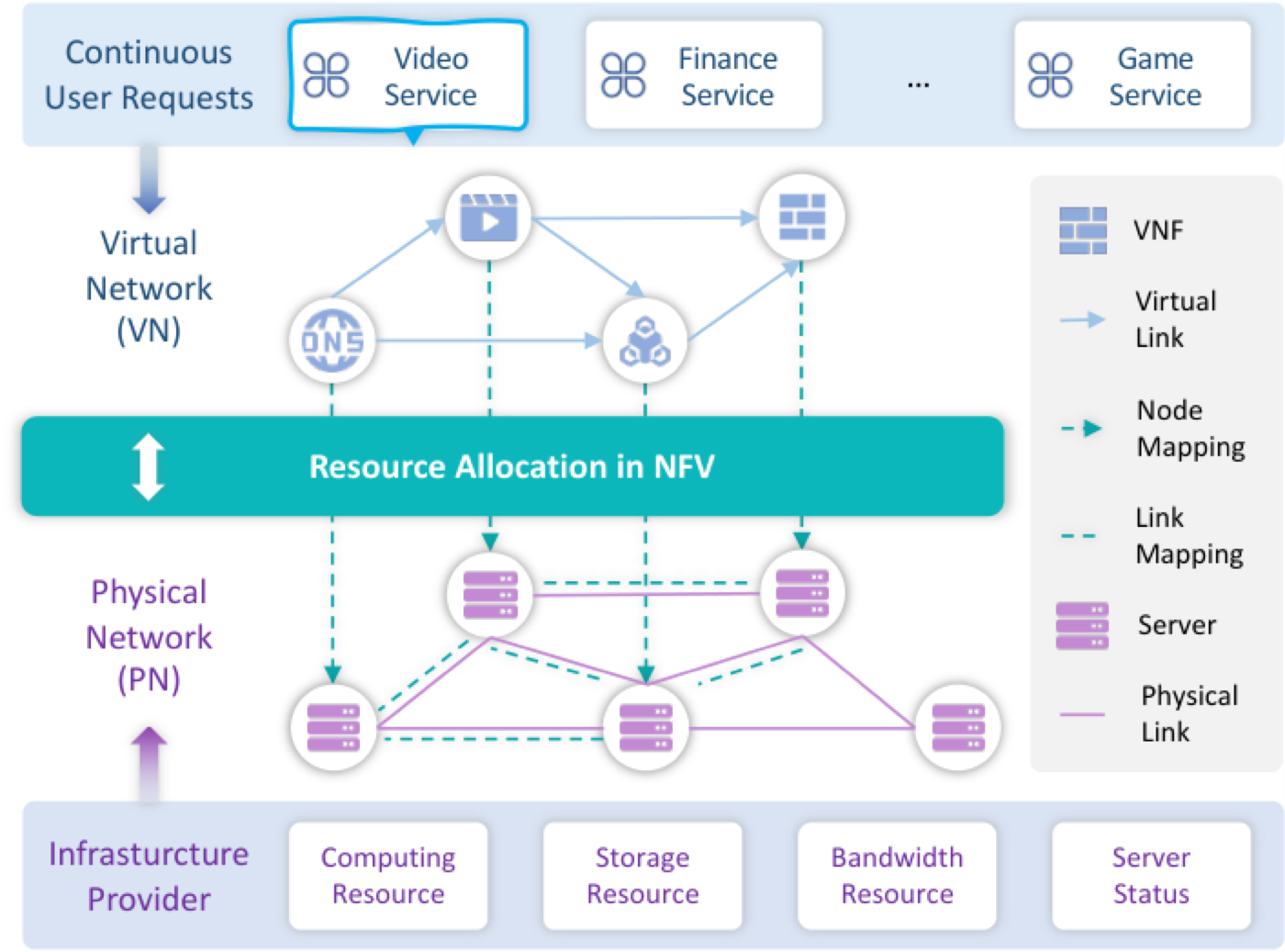
Network Function Virtualization deploys services as virtual networks over shared substrate infrastructure. Deciding which requests to accept, and where to place their nodes and links, is a combinatorial allocation problem known as Virtual Network Embedding, VNF placement, service function chain deployment, or network slicing, depending on who you ask. It is NP-hard, it must be solved online, and it never sees future demand.
Since 2021 this research line has attacked the problem with deep reinforcement learning, from adaptive SFC placement to a generalizable framework, closing with Virne, a benchmark that unifies traditional and learning-based solvers under one Gymnasium-compatible interface.
The research line
Select a row to open its record
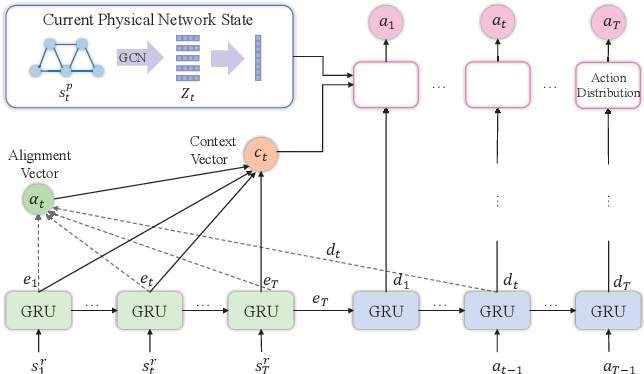
DRL-SFCP: Adaptive Service Function Chains Placement with Deep Reinforcement Learning
An adaptive deep RL method that places service function chains under dynamic traffic and resource conditions.
Tianfu Wang, Qilin Fan, Xiuhua Li, Xu Zhang, Qingyu Xiong, Shu Fu, Min Gao
BibTeX
@INPROCEEDINGS{icc-2021-drl-sfcp,
  author={Wang, Tianfu and Fan, Qilin and Li, Xiuhua and Zhang, Xu and Xiong, Qingyu and Fu, Shu and Gao, Min},
  booktitle={ICC 2021 - IEEE International Conference on Communications},
  title={DRL-SFCP: Adaptive Service Function Chains Placement with Deep Reinforcement Learning},
  year={2021},
  pages={1-6},
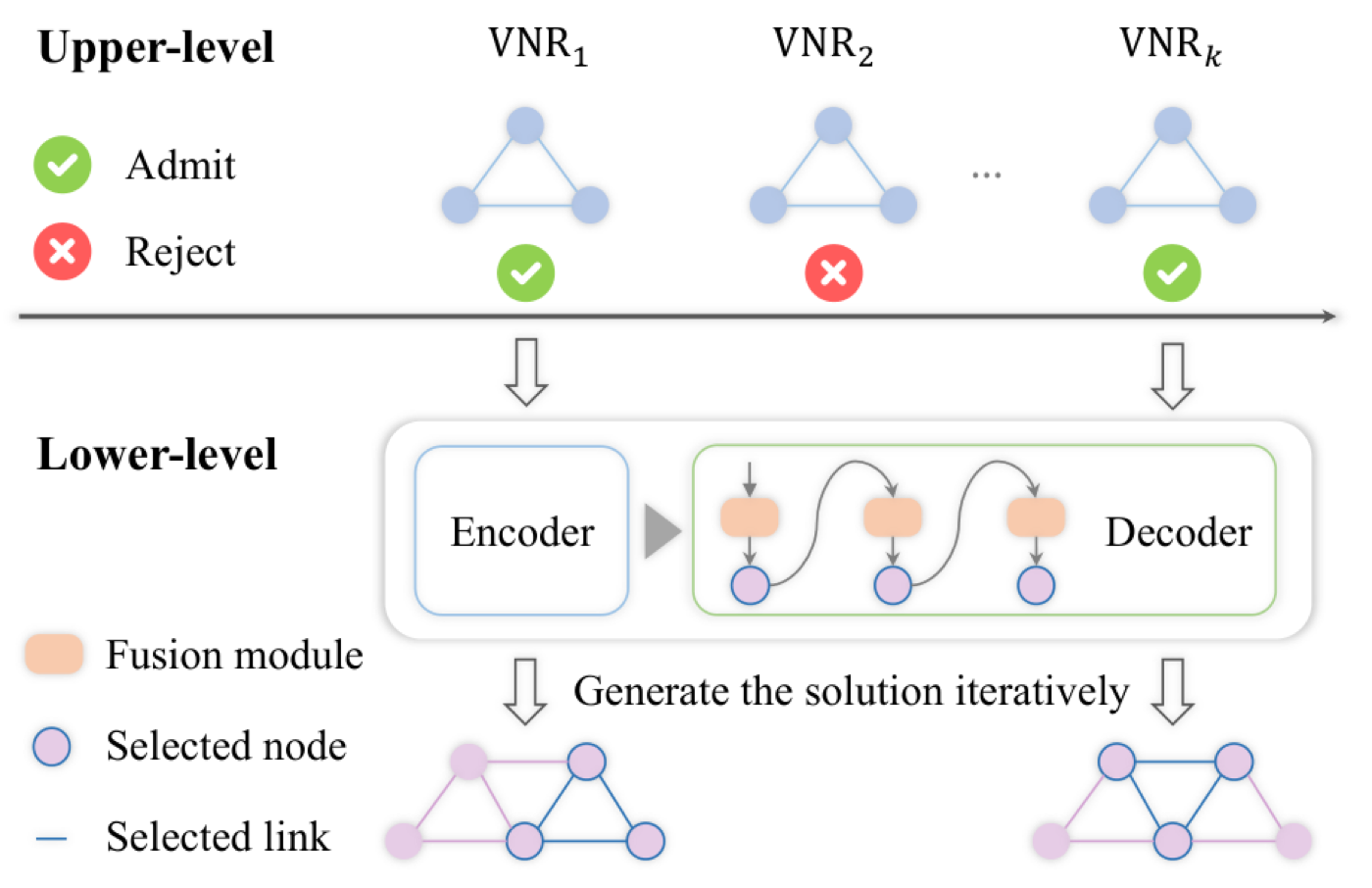
} Joint Admission Control and Resource Allocation of Virtual Network Embedding via Hierarchical Deep Reinforcement Learning
A two-level hierarchical DRL agent that jointly decides which virtual network requests to admit and how to embed them.
Tianfu Wang, Shen Li, Qilin Fan, Tong Xu, Tongliang Liu, Hui Xiong
BibTeX
@ARTICLE{tsc-2023-hrl-acra,
  author={Wang, Tianfu and Shen, Li and Fan, Qilin and Xu, Tong and Liu, Tongliang and Xiong, Hui},
  journal={IEEE Transactions on Services Computing},
  title={Joint Admission Control and Resource Allocation of Virtual Network Embedding Via Hierarchical Deep Reinforcement Learning},
  volume={17},
  number={03},
  pages={1001--1015},
  year={2024},
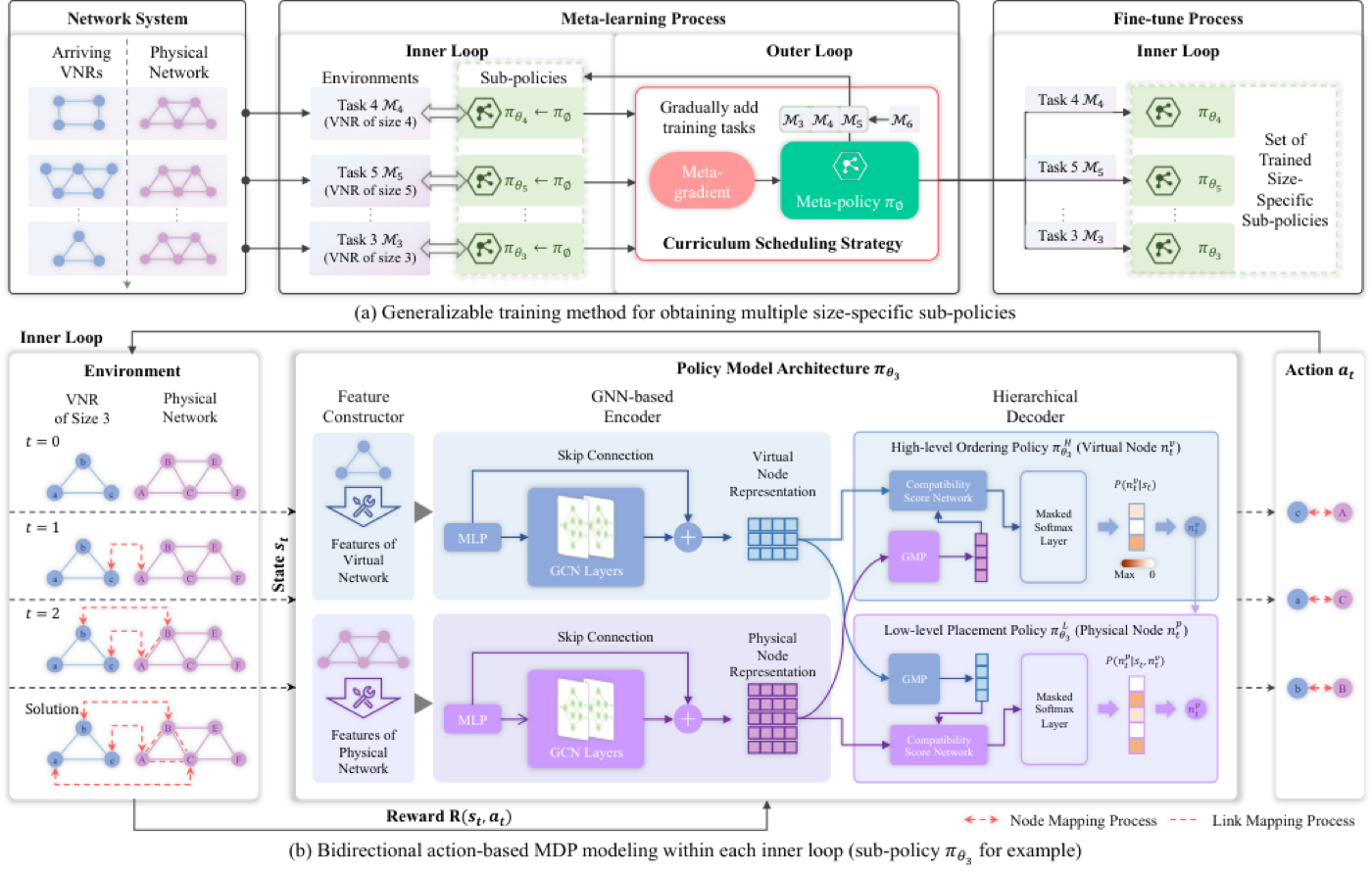
} FlagVNE: A Flexible and Generalizable Reinforcement Learning Framework for Network Resource Allocation
A flexible RL framework that generalizes across NFV resource allocation tasks without task-specific redesign.
Tianfu Wang, Qilin Fan, Chao Wang, Long Yang, Leilei Ding, Nicholas Jing Yuan, Hui Xiong
BibTeX
@INPROCEEDINGS{ijcai-2024-flagvne,
  title={FlagVNE: A Flexible and Generalizable Reinforcement Learning Framework for Network Resource Allocation},
  author={Wang, Tianfu and Fan, Qilin and Wang, Chao and Ding, Leilei and Yuan, Nicholas Jing and Xiong, Hui},
  booktitle={Proceedings of the 33rd International Joint Conference on Artificial Intelligence},
  year={2024},
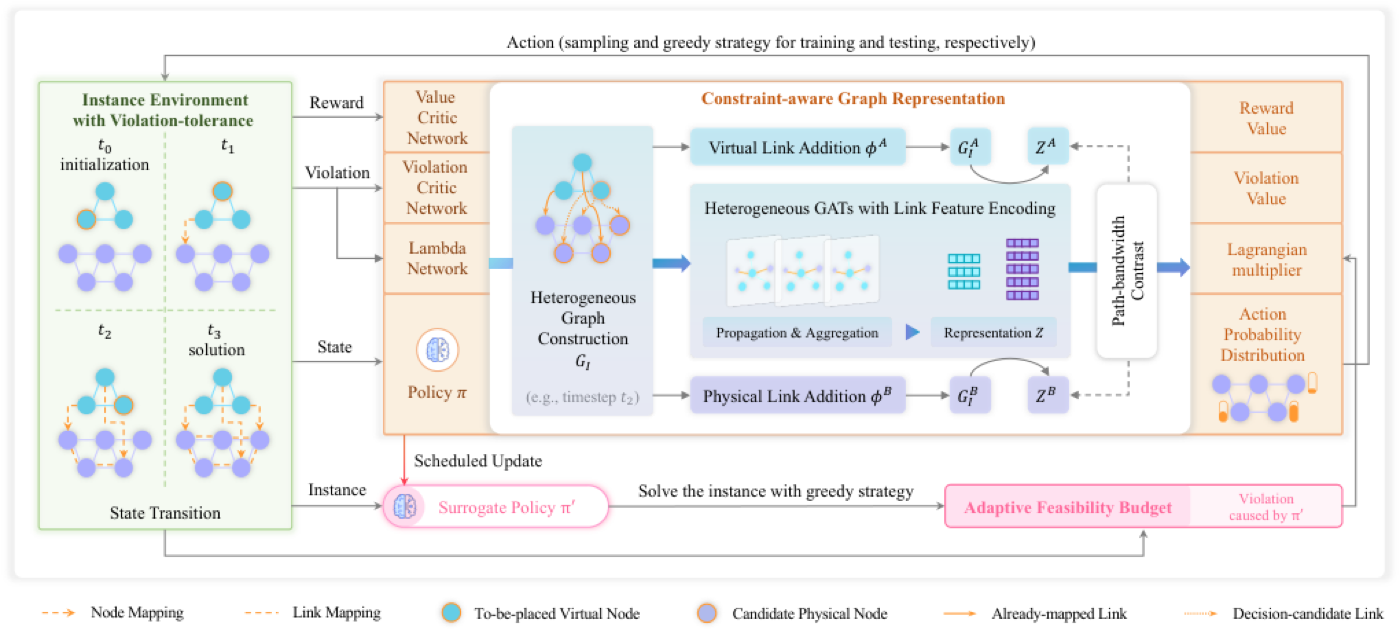
} Towards Constraint-aware Learning for Resource Allocation in NFV Networks
Learning that keeps RL solutions feasible under strict NFV resource constraints.
Tianfu Wang, Long Yang, Chao Wang, Chuan Qin, Liwei Deng, Li Shen, Hui Xiong
BibTeX
@inproceedings{ml4wireless-2025-constraint,
  title={Towards Constraint-aware Learning for Resource Allocation in NFV Networks},
  author={Wang, Tianfu and Yang, Long and Wang, Chao and Qin, Chuan and Deng, Liwei and Shen, Li and Xiong, Hui},
  booktitle={ICML 2025 Workshop on Machine Learning for Wireless Communication and Networks (ML4Wireless)},
  year={2025},
} Virne: A Comprehensive Benchmark for RL-based Network Resource Allocation in NFV
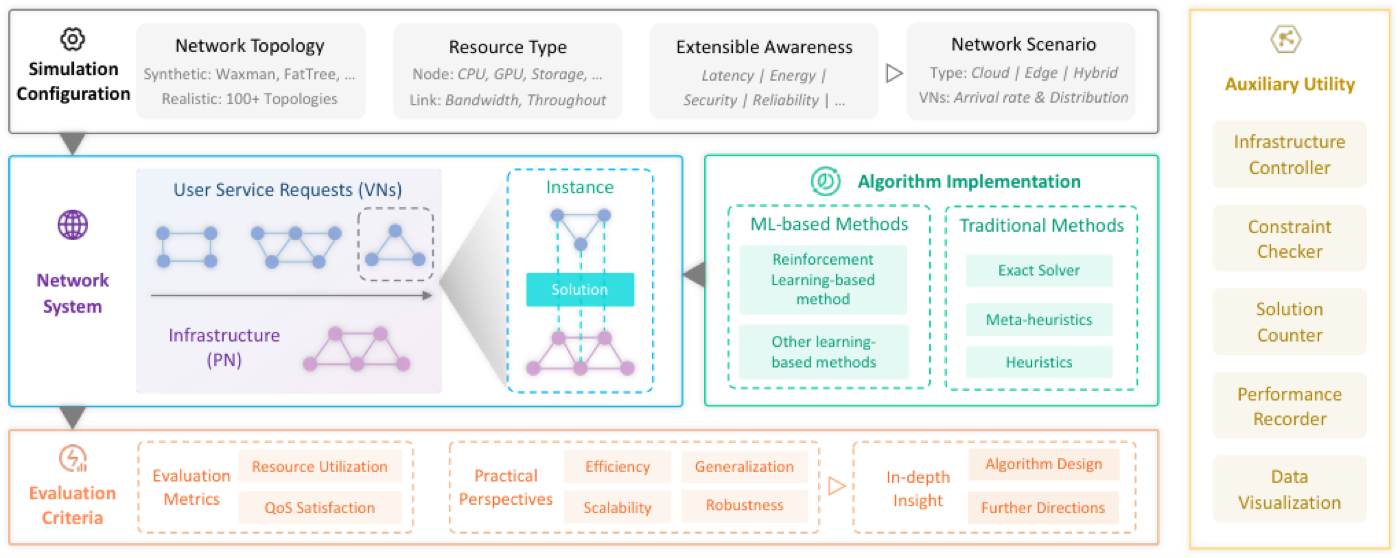
A simulator and benchmark that unifies exact, heuristic, meta-heuristic, and learning-based solvers behind one Gymnasium-compatible interface, evaluated on effectiveness, solvability, generalization, and scalability.
Tianfu Wang, Liwei Deng, Xi Chen, Junyang Wang, Huiguo He, Zhengyu Hu, Wei Wu, Leilei Ding, Qilin Fan, Hui Xiong
BibTeX
@inproceedings{tfwang-2026-virne,
  title={Virne: A Comprehensive Benchmark for RL-based Network Resource Allocation in NFV},
  author={Wang, Tianfu and Deng, Liwei and Chen, Xi and Wang, Junyang and He, Huiguo and Hu, Zhengyu and Wu, Wei and Ding, Leilei and Fan, Qilin and Xiong, Hui},
  booktitle={The Fourteenth International Conference on Learning Representations},
  year={2026},
} The Virne benchmark
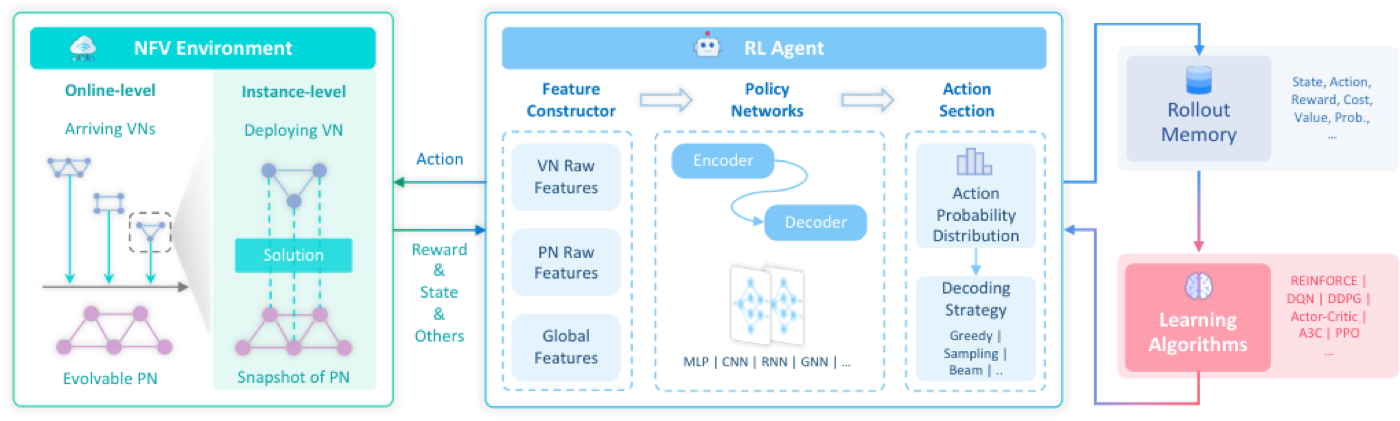
In the literature, resource allocation in NFV appears under many names: Virtual Network Embedding (VNE), Virtual Network Function (VNF) placement, service function chain (SFC) deployment, and network slicing in 5G. Virne brings them into one simulator and benchmark, with unified support for traditional and reinforcement learning based algorithms.
- Simulations
- Diverse network environments (cloud, edge, 5G) with user-defined topologies, resources, and service requirements.
- Solvers
- Over 30 registered algorithms, 10+ of them non-learning: exact, heuristic, meta-heuristic, and learning-based families behind a common interface.
- RL support
- Standardized RL pipelines and Gymnasium-compatible environments for rapid development and benchmarking.
- Evaluation
- In-depth analysis beyond effectiveness: solvability, generalization, and scalability.
Live embedding demo
What you are watching: virtual network requests arrive one at a time, and a simplified greedy node-ranking heuristic decides where to place their nodes and links on the substrate network. Requests hold resources for a bounded lifetime, then leave. Rejections happen when no feasible placement exists. In Virne, this same environment drives over 30 solvers, from exact methods to reinforcement learning agents such as PPO-DualGAT.
Frequently asked
What is Virne?
Virne is a simulator and benchmark for resource allocation in Network Function Virtualization, unifying traditional and reinforcement learning based algorithms behind a common, Gymnasium-compatible interface. The benchmark paper was accepted at ICLR 2026 and the code is Apache-2.0 licensed.
Which problems does Virne cover?
Virtual Network Embedding (VNE), Virtual Network Function (VNF) placement, service function chain (SFC) deployment, and 5G network slicing. Simulations span cloud, edge, and 5G environments with user-defined topologies, resources, and service requirements.
How many algorithms are included?
Over 30 registered algorithms, of which more than 10 are non-learning: exact, heuristic, meta-heuristic, and learning-based families all share one interface, and new solvers plug in via module customization.
How do I install Virne?
Install from PyPI with Python 3.12 or newer: pip install virne. Documentation, examples, and source code are at virne.readthedocs.io and github.com/GeminiLight/virne.
About
RL4Net is maintained by Tianfu Wang, PhD student at The Hong Kong University of Science and Technology (Guangzhou), advised in collaboration with Qilin Fan and Hui Xiong.
Set in Schibsted Grotesk and Fragment Mono. Built with Astro, served by GitHub Pages. Signals on a dark field: cold cyan for the substrate network, warm amber for everything the agents learn. Paper figures are reproduced from the authors' own publications.
Contact: [email protected]. For bugs and feature requests on Virne, open an issue in the repository.