 0:57
Your boss promises on your behalf
Decline the drink and clarify a deadline you never agreed to.
Explore video lessons Try the matching 3D practiceYour personal AI social skills coach
A last-minute task. A toast you want to decline. A friend who still owes you. Practise with an AI character who has a position of their own, then revisit your words and try another response.
Have a situation in mind? Rehearse it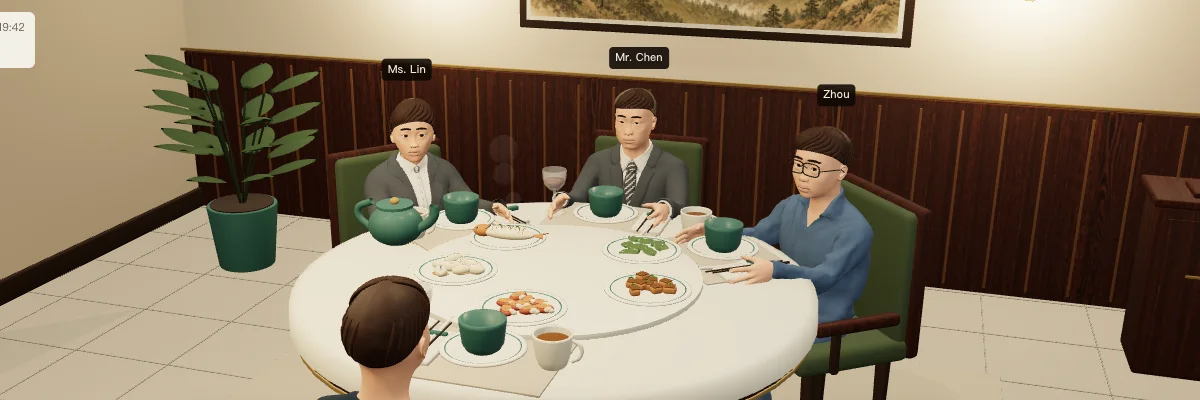 In the app · Work dinner (cropped) Everyone has a cup up—we’re waiting for you.

SocialCoach
Here for the practice. Here for the debrief.
Workplace
Ten minutes before you leave, your manager asks you to stay late — again.
Practise this conversationWorkplace
Your project just shipped; the mid-year comp window closes this week.
Practise this conversationFriendship
Three months, not a word — and they just posted vacation photos.
Practise this conversation01Practice & reflection
Characters have positions of their own. Ask, decline, reconsider or keep talking. When you finish, revisit your own words with the coach and see what happened.
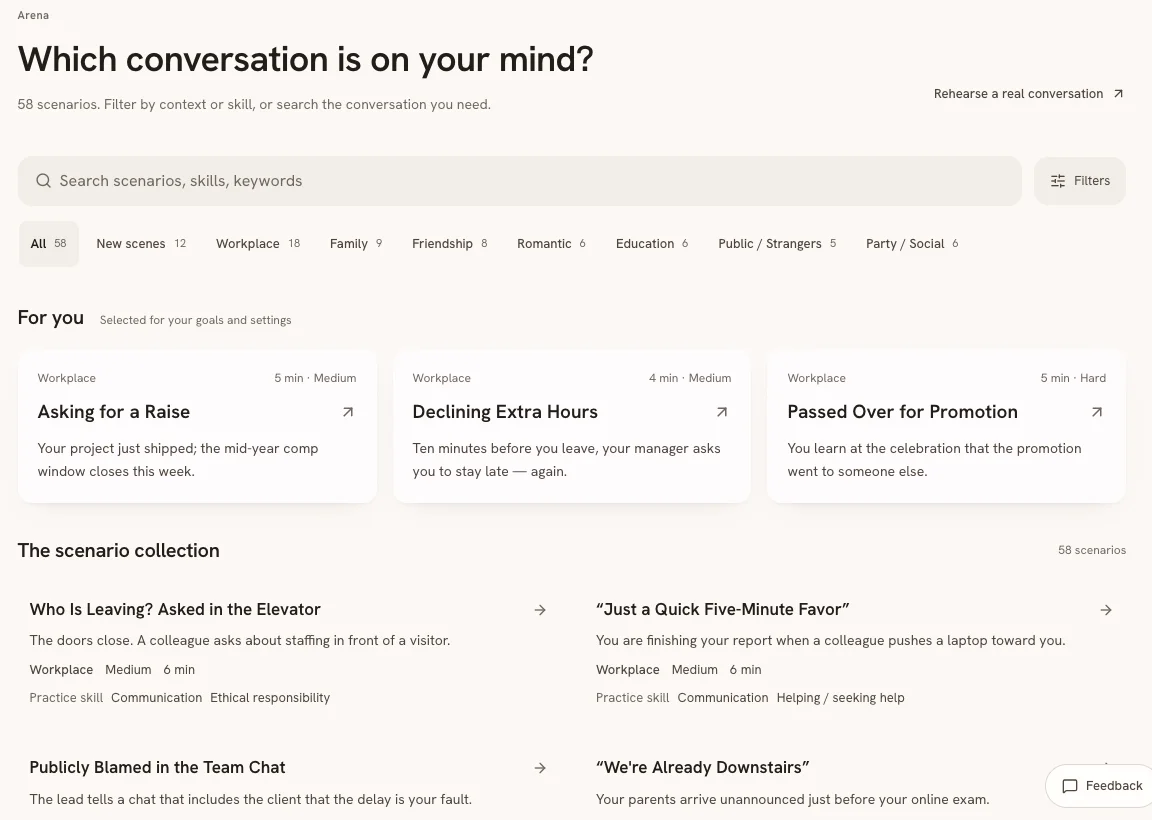
58 bilingual scenarios across seven everyday contexts, plus custom rehearsals for the conversation ahead of you.
Respond in text or use voice input. Add timed replies for more pressure, or keep the conversation going when you need to.
Read specific feedback, try another phrasing and ask the coach follow-up questions. Your practice history helps shape what comes next.
An excerpt from a demo practice
Oh… okay, let me take a look. I do have something tonight though, so I might start a bit late, is that all right?
Demo excerpt. Feedback is generated from each practice conversation.
This debrief revisits “let me take a look” and “is that all right?” The boundary was still unclear, leaving room for more pressure. A specific line gives you something concrete to work on.
See the original debrief screenshotWhy was that line unclear? What if they keep asking? Ask follow-up questions about this practice, and look for recurring patterns across your past conversations.
023D scenes
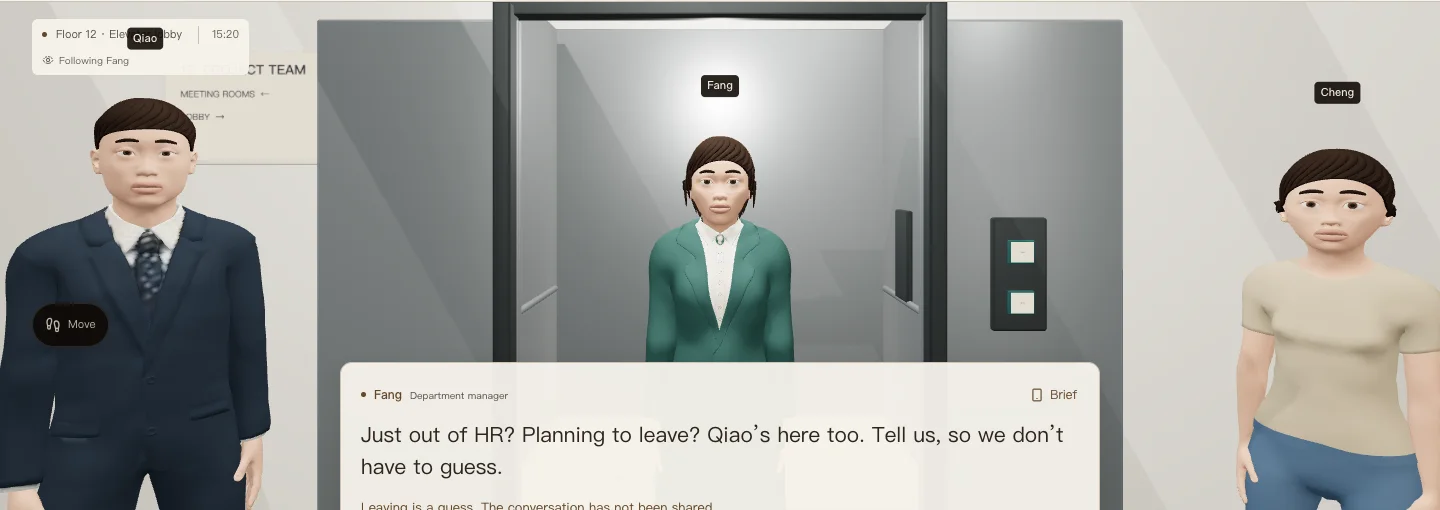
Work, family and school dinners, an elevator lobby and an office. Respond to different people, choose whom to address and handle interruptions.
03Watch & learn
See how different responses change the same conversation. Videos include Chinese and English captions, a breakdown of key choices and a link to the matching 3D practice.
0:57Decline the drink and clarify a deadline you never agreed to.
Explore video lessons Try the matching 3D practice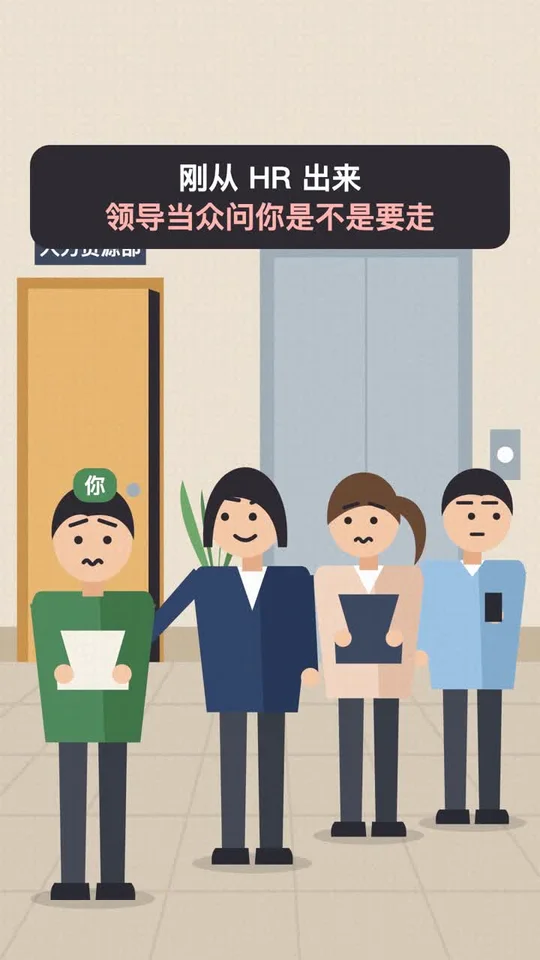 0:51
Everyone is listening. Separate private boundaries from work commitments.
Explore video lessons Try the matching 3D practiceOriginal fictional demonstrations · Chinese audio / Chinese and English captions
Explore 42 strategies and 30 casesConversation practice
Choose a fictional practice scenario shaped around a real-life problem. Speak with a character who has a position of their own, then review what you actually said.
Workplace
Your project just shipped; the mid-year comp window closes this week.
View practiceWorkplace
Ten minutes before you leave, your manager asks you to stay late — again.
View practiceWorkplace
A teammate calls you out in front of the whole team for not giving feedback.
View practiceFamily
After the hundredth time cleaning the kitchen alone, you're done keeping quiet.
View practiceFriendship
Three months, not a word — and they just posted vacation photos.
View practice04Corpus and sources
Every strategy and case carries a source.
The skill map draws on CASEL’s social and emotional learning framework.
Sources include: Difficult Conversations, Nonviolent Communication, Getting to Yes, Crucial Conversations, Never Split the Difference, Radical Candor, The Seven Principles for Making Marriage Work, Thanks for the Feedback.
05Data and deployment
Practice history stays in this browser and can be exported, restored or reset. Generating content sends relevant conversation and practice context to the selected model service.
Anthropic, OpenAI, or any OpenAI-compatible endpoint. Use your own API key or point it at a local model; requests go straight from your browser.
The application is open source under Apache 2.0. Deploy with Docker Compose, Vercel and other platforms; the product corpus and skill map ship with the code.
06Questions
No account is required. Browse scenarios and learning material directly. AI practice uses a shared model quota; if it is exhausted or unavailable, connect your own model in settings. Your provider charges for your own model usage.
A general chat model can play a role once. SocialCoach fixes the training constraints: characters have their own objectives, sometimes with an unspoken concern and won't leak the answer; text practice uses extendable segments and records unmet objectives; afterwards every point quotes the transcript first, then gives attribution, a source and the next practice.
Characters respond according to their goals and the conversation. Politeness does not guarantee agreement. You can negotiate, repair a misunderstanding or hold a boundary; the debrief considers communication and the outcome separately.
The coach model estimates it from each conversation, and the UI says so. Everything it rests on is visible: the quoted line, the dimension, the source. Over several rounds the movement on the radar tells you more than any single number.
Practice history is stored in this browser and can be exported, restored or reset. Relevant context is sent to the selected model service when generating content. Anonymous usage statistics can be disabled in settings; feedback you submit is sent to the team.
Hints name the next move; the words are still yours. The debrief offers a better way to say it, but its job is to get you more reps under pressure.
07Research
Preprint · cs.HC · 2026
arXiv · 2606.04155SocialCoach: Personalized Social Skill Learning with Agentic Tutoring and Practice
1HKUST (Guangzhou) · 2Duke University · 3Microsoft · 4Microsoft Research Asia
The paper frames “what to practise next” as cold-start, retrieval-constrained sequential decision making: given a learner profile, a simulated proficiency state and the practice history, a policy writes a structured prescription that corpus retrieval then realises. The corpus itself is a traceable theory-to-practice framework that both the scheduler and the reflective tutor read from. The distinction every debrief in the app rests on, not knowing the move versus failing to execute it, comes from here too.
@article{wang2026socialcoach,
  title   = {SocialCoach: Personalized Social Skill Learning with Agentic Tutoring and Practice},
  author  = {Wang, Tianfu and Xiong, Max and Lei, Yuxuan and Lian, Jianxun and Zhu, Hongyuan
             and Hu, Zhengyu and Gong, Linxiao and Hu, Dapeng and Li, Xiaofang and Tsai, Peiting
             and Yuan, Nicholas Jing and Zhang, Qi},
  journal = {arXiv preprint arXiv:2606.04155},
  year    = {2026}
}
Ask for a raise, bring up an unpaid loan or finally talk through something you have put off. Start with the conversation that matters to you.